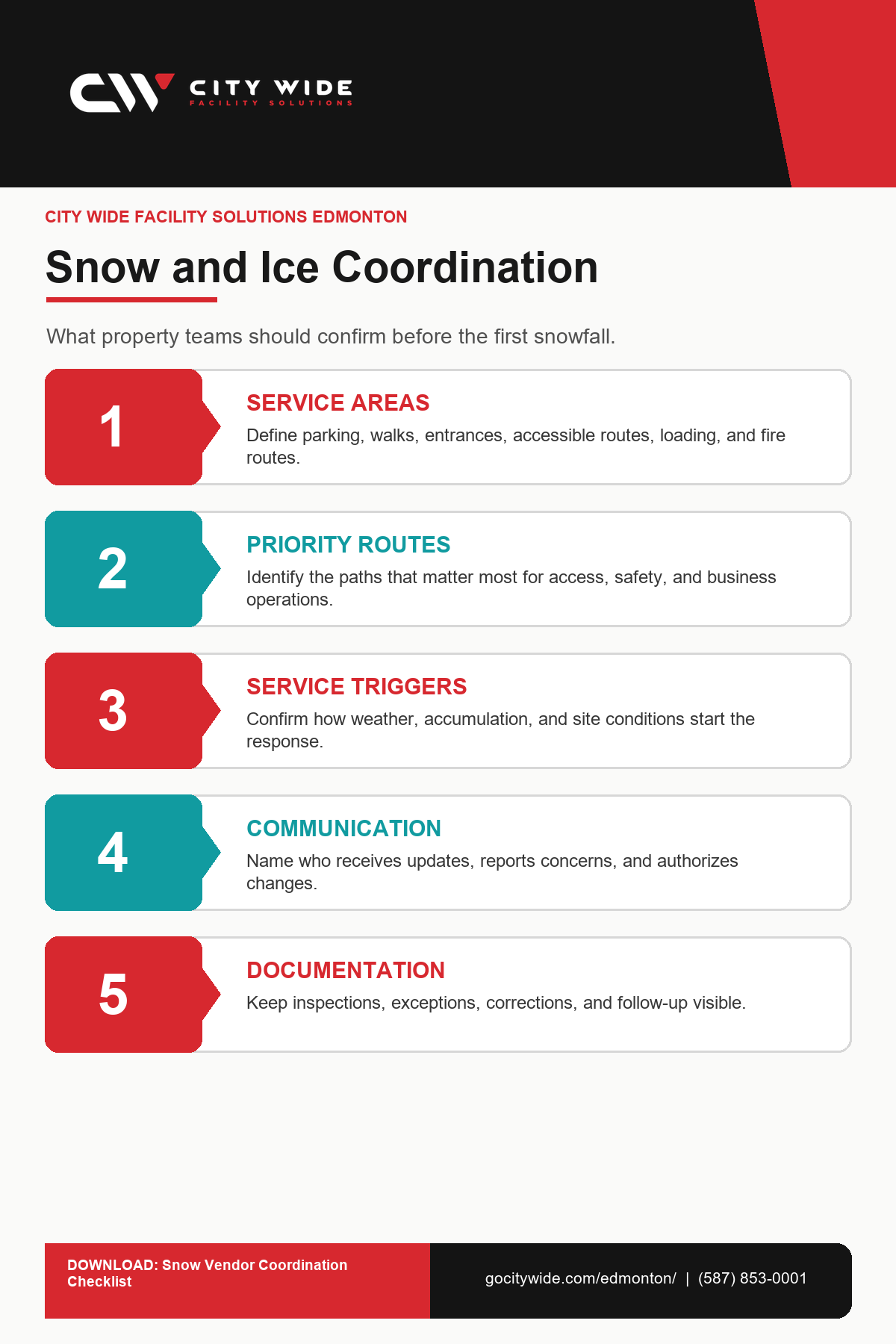
Property managers should confirm the covered areas, priority routes, service triggers, communication process, documentation, and escalation responsibilities before the first snowfall. These details make it easier to compare plans and respond consistently across changing winter conditions.
Map the property before weather arrives
List parking areas, sidewalks, entrances, accessible routes, loading areas, fire routes, waste areas, and any location-specific concerns. Mark the routes that need priority attention for visitors, tenants, deliveries, emergency access, or business continuity. A site map turns a general service agreement into an operating plan.
Ask how service starts and changes
The plan should explain what conditions trigger service, how weather is monitored, how crews are dispatched, and how changing conditions are communicated. Ask who can authorize additional work, how blocked access is handled, and what happens when a priority route needs a correction.
Compare accountability, not only scope
Two proposals may list similar areas but provide different levels of oversight. Review inspection practices, reporting, after-hours contacts, response updates, correction procedures, and the provider’s ability to coordinate related winter services. The clearest plan makes ownership visible.
How City Wide helps
City Wide Facility Solutions Edmonton helps clients coordinate snow removal and related winter facility services through one point of contact. That approach supports communication oversight, quality follow-up, and a clearer route for managing multiple service needs.
Quick checklist
- List covered areas and priority routes
- Confirm service triggers and monitoring
- Name communication and escalation contacts
- Define documentation and correction follow-up
Frequently asked questions
What should a snow and ice scope include?
It should define covered areas, priority routes, service triggers, communication expectations, documentation, and the process for exceptions or corrections.
Why do priority routes matter?
Entrances, accessible paths, loading areas, and high-traffic walkways can affect access and operations differently than low-use areas.
How should multi-site operators compare plans?
Use the same scorecard for every location, then record the site-specific routes, access instructions, and escalation contacts.
Who should receive service updates?
The agreement should identify the property contact, backup contact, tenant or site communication route, and after-hours process.
What should happen when service quality is a concern?
The plan should identify how the issue is reported, who owns correction, and how completion is documented.
Download the checklist
Download the Snow Vendor Coordination Checklist to help document service requirements, compare options, and prepare for a facility conversation.
Schedule a complimentary facility consultation
City Wide Facility Solutions Edmonton helps commercial properties coordinate cleaning, maintenance, seasonal services, vendor communication, inspections, and follow-up through one point of contact.
City Wide Facility Solutions Edmonton
Unit 206, 3601 82 Ave
Leduc, AB T9E 0H7
(587) 853-0001
gocitywide.com/edmonton/